Where a tree crane can stand is decided by the ground under its outriggers
A tree crane needs a firm, level spot within reach of the tree, off any septic system and soft ground, with its boom clear of power lines. With the outriggers set, every lift's weight travels down through them, so the setup spot is settled first.
Outriggers carry the load the tires cannot
Outriggers are steel legs that extend from each side of a crane truck and press on the ground, widening the base the crane balances on. NIOSH's crane stability talk, written for construction crews, explains the need: "When a crane lifts and moves a load, the distance from the load's center of gravity to the crane's tipping axis changes." A piece of trunk out on the boom pulls the truck toward it, and the outriggers resist.
The general-industry crane rule, 29 CFR 1910.180, which OSHA's tree-care memo names for truck-mounted cranes, ties outrigger use to the maker's own rating and calls for a setup in which "The crane is level and where necessary blocked properly." The crane-assisted removal page says where the crane usually sets up; this page explains why.
Pads spread the push, and pavement usually takes it best
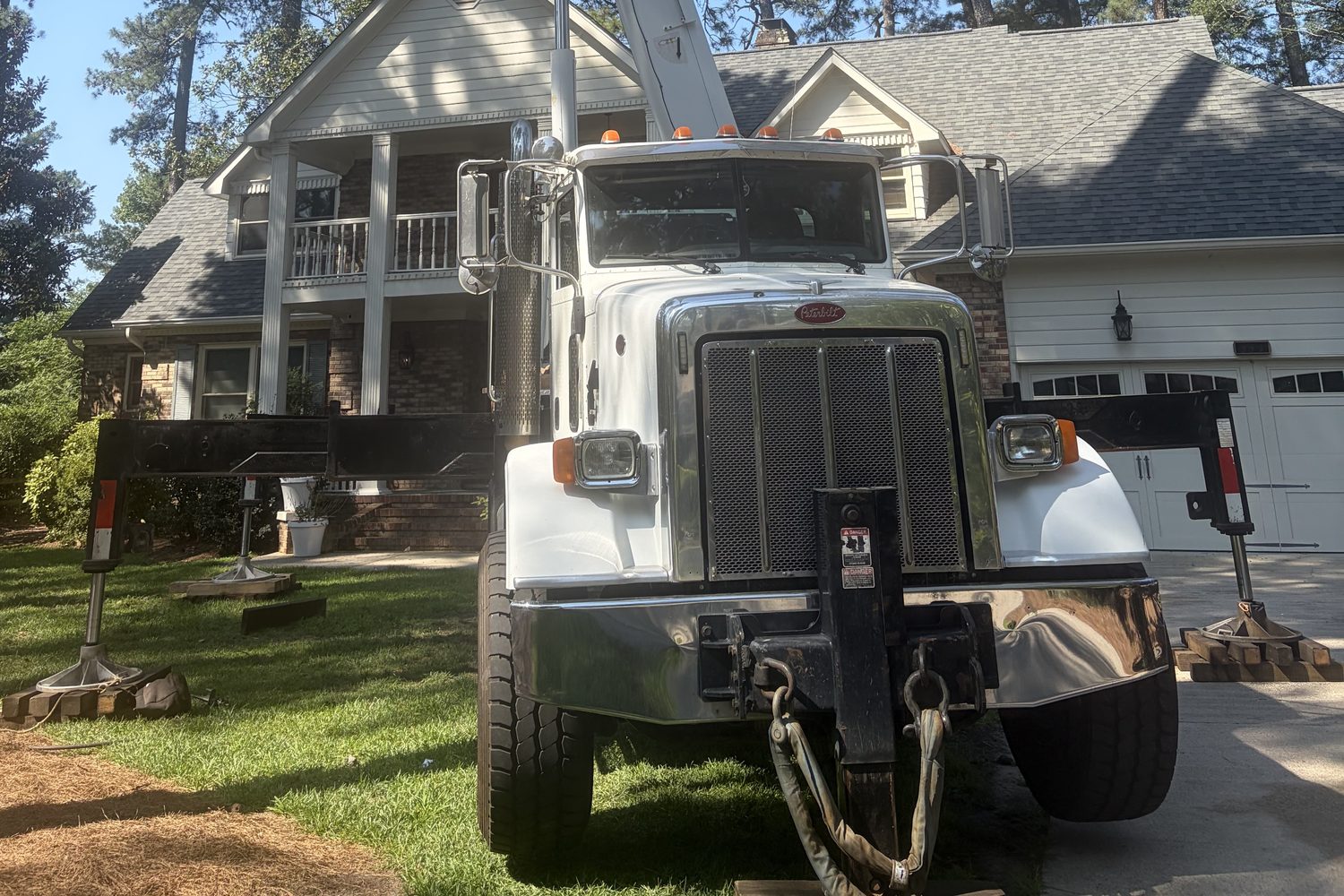 The crew's own photo
Each outrigger foot goes down on pads, mats or stacked timber to spread its weight. OSHA's general-industry crane rule, 29 CFR 1910.180, says wood blocks under outriggers must "Be strong enough to prevent crushing" and "Be of sufficient width and length to prevent shifting or toppling under load." How much pad a given crane needs comes from its maker and load chart, not from this page.
That rule also counts "ground conditions" among the factors that influence stability. A driveway is built to carry vehicles and sheds water; a lawn can be soft after rain.
Soft fill, slopes and septic fields make poor footing
Backfilled ground can settle under a concentrated load, a slope starts the truck off level, and a wet low spot gives. NC State Extension's septic owner's guide gives homeowners a general rule that says nothing about cranes in particular: "Don't drive vehicles over the system." It also suggests marking the tank and the drainfield boundaries. No source read for this page gives a crane setback from a drainfield. If you do not know where yours are, your septic records or the county's environmental health office are the places to ask.
Setting up in the street is the road owner's decision
None of the city or state pages cited here names a crane set-up for tree work as a permit trigger, so ask the road's owner.
- Lexington: Engineering Services lists a Right-of-Way Encroachment Permit Application. The form, as captured in November 2025, asks "Closing a road, lane, shoulder, sidewalk, etc?" and requires a detour plan for road closures.
- Thomasville: the Streets Division says it is "responsible for paving, maintaining, and patching city streets, sidewalks and rights-of-way." No street-use permit appeared on the city's permit pages as captured during 2025, so the City of Thomasville is who to ask.
- State roads: NCDOT's utilities encroachment page says an agreement is required "When construction or utility installation is proposed within the limits of NCDOT right-of-way". For a temporary set-up, ask the NCDOT district office.
Overhead lines: notice, arrangements and who decides
Under North Carolina's Overhead High-Voltage Line Safety Act, G.S. 95-229.5 to 95-229.13, a crane is covered equipment, and unless the danger has been guarded against as the Act provides, no work may cause "Any part of any covered equipment or covered item used by the individual, agent, employee, or other person to be brought within 10 feet of any high-voltage line." A high-voltage line is one "in excess of 600 volts measured between conductor and ground", and which wires meet that is the utility's to say.
To work closer than that, the Act makes the person responsible for the work notify the line's owner or operator ahead of time; the notice period, and who pays for the utility's precautions, are taken apart on crane-assisted tree removal cost. Which precaution fits, whether temporary barriers, de-energizing and grounding, or raising the line, is the owner or operator's call, and the answer can be that nothing allows the work to go ahead safely or at reasonable cost. Whoever does the work may not move the line or push a pole to make room.
The service wire to the house is its own question
The service drop, the wire from the pole to the meter, can cross the space a crane needs. OSHA's general-industry rule for work near overhead lines, 29 CFR 1910.333(c)(3), says: "If work is to be performed near overhead lines, the lines shall be deenergized and grounded, or other protective measures shall be provided before work is started."
For Duke Energy customers, Duke's rights-of-way FAQ says of the line between the pole and the meter that "the property owner has primary responsibility to keep these lines clear of trees and vegetation" and asks owners or their contractors to request that the service line be de-energized before tree work; Duke says it does not charge for it. For EnergyUnited or Lexington Utilities, ask the utility. When a storm has already brought that wire down, who to call about a tree on a power line covers whose equipment is whose.
What a homeowner can have ready for a planned crane job
On a planned job, a few things only the homeowner knows decide where the crane can stand. A storm night runs in a different order, set out in the first hour once a storm drops a tree.
Whether the tree needs a crane at all is weighed under crane or climber, and the work follows a crane removal day from setup to cleanup. Worth having ready at the quote visit:
- Where the septic tank and drainfield are, marked if you can
- Soft or wet spots and filled ground
- Where the cars can go, so the driveway is clear
- Gates, locks and anything that narrows the way in
- Which company sends the power bill, if a wire runs near the tree
Where would the crane stand at your house?
Questions people actually ask.
Can a crane set up on a lawn?
Yes, when the ground is firm and level enough, with pads or mats under the outriggers. Soft, sloped or wet lawn is poorer footing than pavement, and the crane's chart and operator decide.
Can the crane park on my septic field?
Not according to NC State Extension's septic owner's guide, which tells homeowners not to drive vehicles over the system. The guide makes no exception for a crane.
Who has to notify the power company when a crane works near a line?
North Carolina's Overhead High-Voltage Line Safety Act puts it on the person responsible for the work, defined as whoever performs or controls the work that needs the precautions. Settle who that is at the quote visit.
Why might pads go down even on a paved driveway?
Pads spread each outrigger's push over more surface, and pavement can crack or give at an edge under a concentrated load like any other surface.